
Performs spectral clustering with spatial constraints by combining spatial connectivity with attribute similarity using kernel methods. This approach is useful for clustering with highly non-convex clusters or irregular topologies in geographic contexts.
Usage
spenc(
  data,
  attrs = NULL,
  n_regions,
  weights = "queen",
  bridge_islands = FALSE,
  gamma = 1,
  scale = TRUE,
  seed = NULL,
  verbose = FALSE
)
Arguments
- data
An sf object with polygon or point geometries.
- attrs
Character vector of column names to use for clustering (e.g.,
c("var1", "var2")). If NULL, uses all numeric columns.- n_regions
Integer. Number of regions (clusters) to create.
- weights
Spatial weights specification. Can be:
"queen"(default): Polygons sharing any boundary point are neighbors"rook": Polygons sharing an edge are neighborsAn
nbobject from spdep or created withsp_weights()A list for other weight types:
list(type = "knn", k = 6)for k-nearest neighbors, orlist(type = "distance", d = 5000)for distance-based weights
- bridge_islands
Logical. If TRUE, automatically connect disconnected components (e.g., islands) using nearest-neighbor edges. If FALSE (default), the function will error when the spatial weights graph is disconnected.
- gamma
Numeric. RBF kernel parameter controlling attribute similarity decay. Larger values = faster decay = more local similarity. Default is 1. Can also be "auto" to estimate from data.
- scale
Logical. If TRUE (default), standardize attributes before clustering.
- seed
Optional integer for reproducibility.
- verbose
Logical. Print progress messages.
Value
An sf object with a .region column containing cluster assignments.
Metadata is stored in the "spopt" attribute, including:
algorithm: "spenc"
n_regions: Number of regions created
objective: Within-cluster sum of squared distances in embedding space
gamma: The gamma parameter used
solve_time: Time to solve in seconds
Details
SPENC (Wolf, 2021) extends spectral clustering to incorporate spatial constraints. The algorithm:
Computes attribute affinity using an RBF (Gaussian) kernel
Multiplies element-wise with spatial weights (only neighbors have affinity)
Computes the normalized Laplacian of the combined affinity matrix
Extracts the k smallest eigenvectors as a spectral embedding
Applies k-means clustering to the embedding
Key advantages:
Can find non-convex cluster shapes
Respects spatial connectivity
Balances attribute similarity with spatial proximity
The gamma parameter controls how quickly attribute similarity decays with distance in attribute space. Larger values create more localized clusters.
References
Wolf, L. J. (2021). Spatially-encouraged spectral clustering: a technique for blending map typologies and regionalization. International Journal of Geographical Information Science, 35(11), 2356-2373. doi:10.1080/13658816.2021.1934475
Examples
# \donttest{
library(sf)
nc <- st_read(system.file("shape/nc.shp", package = "sf"))
#> Reading layer `nc' from data source
#> `/Library/Frameworks/R.framework/Versions/4.6/Resources/library/sf/shape/nc.shp'
#> using driver `ESRI Shapefile'
#> Simple feature collection with 100 features and 14 fields
#> Geometry type: MULTIPOLYGON
#> Dimension: XY
#> Bounding box: xmin: -84.32385 ymin: 33.88199 xmax: -75.45698 ymax: 36.58965
#> Geodetic CRS: NAD27
# Basic SPENC with 8 regions
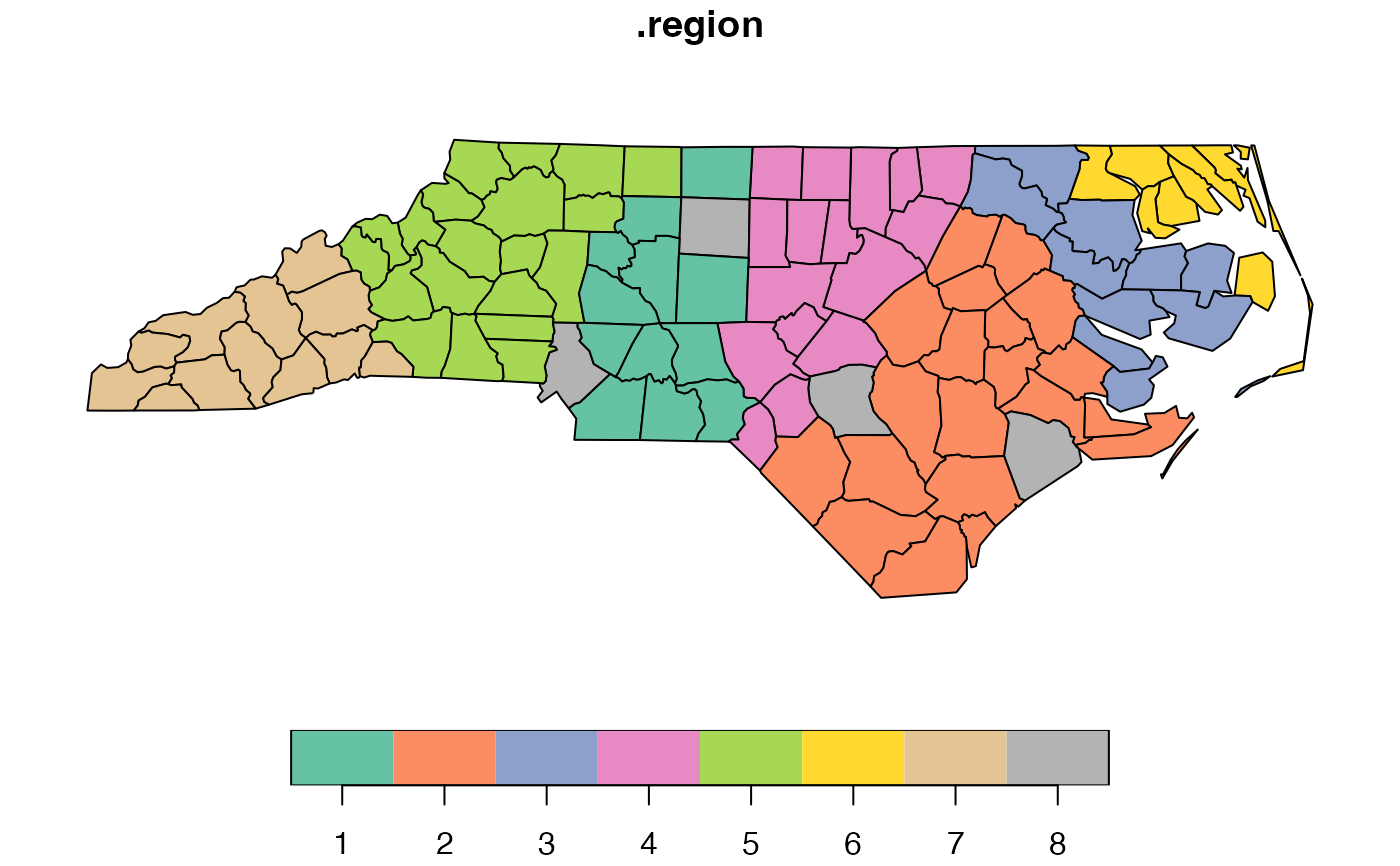
result <- spenc(nc, attrs = c("SID74", "SID79"), n_regions = 8)
# Adjust gamma for different cluster tightness
result <- spenc(nc, attrs = c("SID74", "SID79"), n_regions = 8, gamma = 0.5)
# View results
plot(result[".region"])
 # }
# }